

Industrial packaging is not simply about choosing a strong container. The right drum depends on what you are storing, how the material is filled and discharged, how it will be transported, and the conditions it may encounter along the way.
This is where the choice between open top vs closed top steel drums becomes important.
Both are widely used as industrial steel drums, but they are designed around different operating requirements. Open top drums provide wider access to the contents, while closed top drums are designed for controlled filling and dispensing through dedicated openings.
At East India Drums & Barrels (EIDB), both open top and closed top steel drums are manufactured to serve different industrial packaging needs. Rather than treating one format universally better than the other, the right approach is to understand how each drum works and determine which configuration suits the product and process.
So, what is the difference between open top and closed top steel drums, and which one should your industry choose? Let us break it down.
Understanding Open Top and Closed Top Steel Drums
The fundamental difference between the two drum types lies in their construction and the way users access the contents.
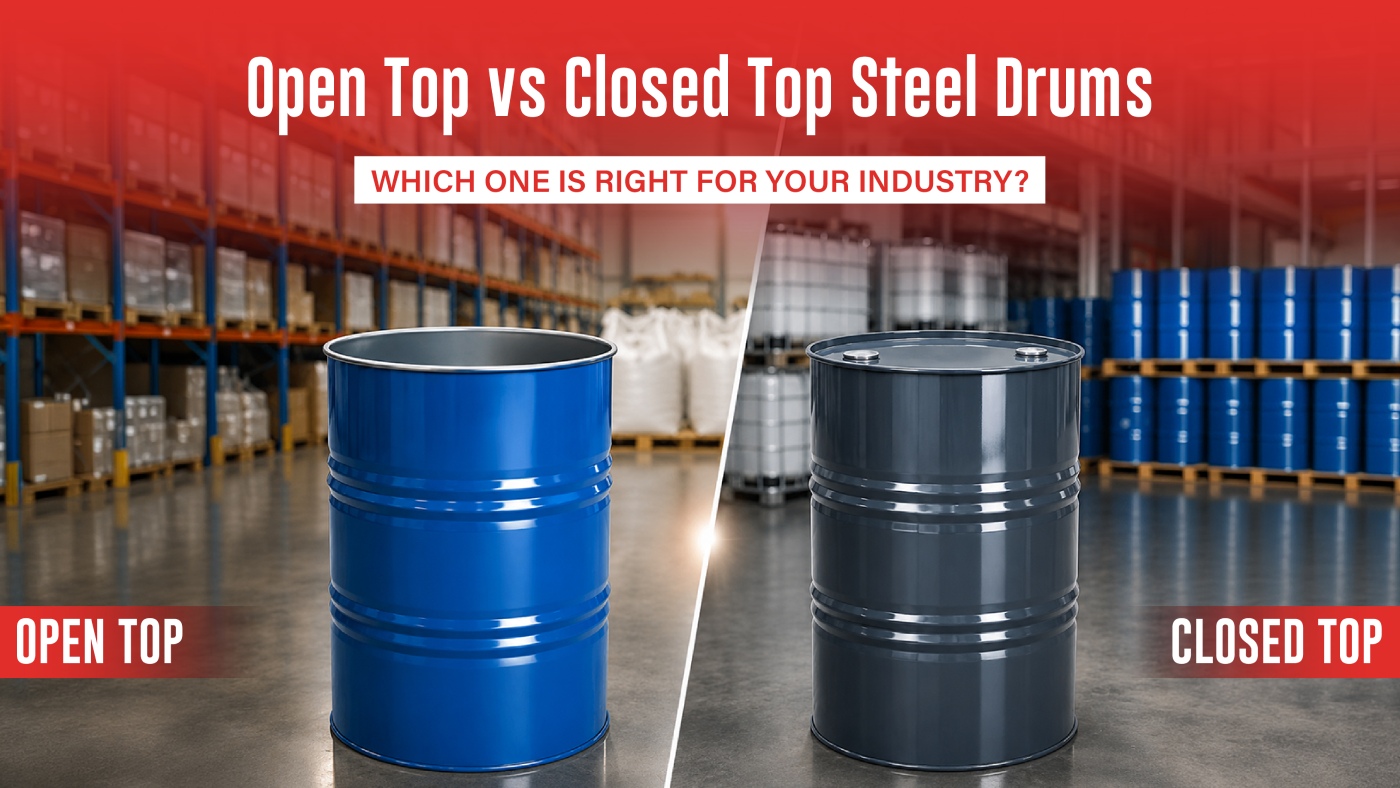
Open top steel drums have a removable top or lid that provides access to almost the entire drum opening. This makes filling, emptying and accessing the stored material relatively straightforward.
Closed top steel drums, on the other hand, have a permanently fixed top with smaller openings, commonly known as bungs, through which the material can be filled or discharged.
This structural difference influences everything from the types of materials they can accommodate the way they fit into industrial filling, storage and transportation processes.
What Are Open Top Steel Drums?
As the name suggests, open top steel drums are designed with a removable lid. Once the lid is removed, users have wide access to the inside of the drum.
The lid can be secured after filling using an appropriate closure mechanism, depending on the drum design.
The key advantage here is accessibility.
Because the entire top can be opened, these drums can be particularly useful for products that cannot conveniently be poured or pumped through a small opening.
Depending on product compatibility and drum specifications, open top drums can be considered for materials such as:
- Powders
- Granules
- Pastes
- Greases
- Semi-solid products
- Viscous materials
- Certain solid industrial materials
They can also be useful in operations where the contents need to be manually accessed or removed using industrial tools or equipment.
How Do Open Top Steel Drums Work?
The operating principle is relatively simple.
The lid is removed for filling, providing a large opening through which the material can be filled. Once filled, the lid is placed back onto the drum and secured with the specified closure system.
At the destination, the lid can be removed again, allowing direct access to the material.
This makes open top steel drums especially practical when accessibility is an important part of the production or handling process.
What Are Closed Top Steel Drums?
Closed top steel drums operate on a different principle.
Instead of a removable lid, the top is permanently attached to the drum body. Access to the contents is provided through smaller openings fitted with screwed closures.
Products can be filled into or discharged from the drum through these openings using suitable filling, pumping or dispensing systems.
This configuration is particularly useful for flowable materials and liquids where controlled filling and dispensing are required.
Depending on the drum specification, internal lining and compatibility requirements, closed top drums may be considered for industrial products such as:
- Oils
- Lubricants
- Solvents
- Paints and coatings
- Petroleum-related products
- Certain liquid chemicals
- Agro chemicals
- Fragrances and aroma chemicals
- Honey, ghee and other food items
- Other flowable industrial materials
For applications involving steel drums for chemical storage, however, the drum specification should always be selected according to the characteristics of the chemical, applicable regulations and material compatibility.
How Do Closed Top Steel Drums Work?
Instead of opening the entire top, material is filled and emptied through the drum’s dedicated openings.
After filling, the openings are securely closed using the appropriate closures. The contents can later be poured, pumped or otherwise discharged through these openings depending on the application.
This makes closed top drums particularly relevant to industrial operations with controlled liquid filling and dispensing processes.
Open Top vs Closed Top Steel Drums: What’s the Difference?
| Factor | Open Top Steel Drums | Closed Top Steel Drums |
|---|---|---|
| Top Construction | Removable lid | Permanently fixed top |
| Access | Wide access to contents | Access through smaller openings |
| Filling | Suitable for direct or wide-mouth filling | Suitable for controlled filling through openings |
| Typical Material Form | Solids, powders, pastes, semi-solids and viscous products | Liquids and other flowable products |
| Emptying | Contents can be accessed directly | Contents are generally poured or pumped out |
| Cleaning Access | Easier internal access | More restricted internal access |
| Primary Advantage | Accessibility and versatility | Controlled filling and dispensing |
| Selection Depends On | Product and process requirements | Product and process requirements |
When Should You Choose an Open Top Steel Drum?
An open top drum may be the more practical option when the product cannot easily pass through a small opening or when direct access to the contents is necessary.
For example, a manufacturer handling a thick paste may need to scoop or mechanically remove the product from the container. Trying to perform the same operation through a small bung opening would be impractical.
Similarly, powders, granules and certain solid materials can benefit from the wider filling and emptying area.
Open top drums may therefore be suitable when:
- Wide-mouth filling is required
- The material is solid, semi-solid or highly viscous
- Direct access to the contents is important
- The product needs to be scooped or manually removed
- Easier access to the drum interior is operationally beneficial
The key consideration is not simply the nature of the product but how that product moves through your process.
When Should You Choose a Closed Top Steel Drum?
Closed top drums become particularly useful when the material is liquid or flowable and can be efficiently transferred through dedicated openings.
For industries using automated or controlled filling systems, this design can integrate effectively into the packaging process.
Closed top drums may therefore be considered when:
- The product is liquid or easily flowable
- Controlled filling is required
- Pumping or pouring is part of the process
- Wide access to the drum interior is unnecessary
- The filling and dispensing system is designed around drum openings
For businesses looking for steel drums for industrial use, understanding the filling and dispensing process is therefore just as important as understanding the material itself.
What About Steel Drums for Chemical Storage?
Chemical packaging requires additional consideration because chemicals can vary substantially in their properties.
There is no universal steel drum suitable for every chemical.
When evaluating steel drums for chemical storage, businesses should consider factors such as:
- Chemical composition
- Compatibility with steel
- Internal coating or lining requirements
- Product characteristics
- Filling conditions
- Storage environment
- Transportation requirements
- Applicable safety and regulatory requirements
Some chemical applications may be suited to closed top drums because the contents are liquid and benefit from controlled filling and dispensing. Other products may require a different drum configuration.
This is why chemical storage requirements should be evaluated with the manufacturer rather than selecting a drum based only on whether it is open top or closed top.
How to Choose the Right Steel Drum
If you are wondering how to choose the right steel drum, start with the product and the process rather than the drum itself.
Ask these questions:
1. What are you storing?
Determine whether the product is liquid, solid, powdered, semi-solid, viscous or another form.
2. How will the drum be filled?
Consider whether your operation requires a wide opening or controlled filling through smaller openings.
3. How will the product be removed?
Will it be poured, pumped, scooped or discharged using another process?
4. Does the product require a specific internal lining or coating?
Product compatibility should always be considered when determining drum specifications.
5. How will the drum be handled and transported?
Consider the conditions the packaging may encounter throughout the supply chain.
6. Are there specific regulatory requirements?
Certain products and applications may require drums that meet relevant packaging and transportation requirements.
Once these questions are answered, choosing between open top vs closed top steel drums becomes significantly easier.
EIDB Open Top Steel Drums: Designed for Accessibility
At East India Drums & Barrels (EIDB), open top drums are manufactured for industrial applications where accessibility and ease of filling are important considerations.
Their removable-top configuration makes them suitable for various products that require a wider opening during filling or discharge.
For businesses handling powders, solids, viscous products or semi-solid materials, the open top design can offer a practical packaging solution when matched with the correct drum specifications.
The objective is straightforward: make the contents easier to fill, access and remove while providing the strength expected from industrial steel packaging.
EIDB Closed Top Steel Drums: Designed for Controlled Handling
EIDB’s closed top steel drums address a different set of industrial requirements.
With fixed-top construction and dedicated openings, these drums can be suited to liquid and flowable products where controlled filling and dispensing are important.
They can support applications across industries dealing with oils, lubricants, paints, coatings, food products, pharma products, aroma chemicals and other industrial liquids, subject to appropriate drum specifications and product compatibility.
Here, the fundamental advantage is not wide accessibility but controlled movement of the contents into and out of the drum.
Two Drum Types. Two Different Purposes.
The choice between open top and closed top drums should never be reduced to asking which one is “better.”
The better question is:
Which drum works better for your product and your process?
Open top drums priorities accessibility. Closed top drums priorities-controlled filling and dispensing.
Both configurations benefit from the strength and durability associated with industrial steel drums, but each serves a distinct role within industrial packaging.
That is why EIDB manufactures both categories with a wide range of sizes from 10L to 235L, enabling businesses to choose steel packaging according to their operational requirements rather than forcing different applications into a single drum format.
Conclusion
Understanding the difference between open top and closed top steel drums is essential when selecting packaging for industrial operations.
Choose open top steel drums when wide access, easy filling or direct removal of solid, semi-solid, powdered or viscous materials is important.
Choose closed top steel drums when handling suitable liquids or flowable materials that can be filled and discharged through dedicated openings.
For applications involving steel drums for chemical storage, additional factors such as product compatibility, internal coatings, closures and regulatory requirements should always be considered.
With both open top and closed top options, catered in sizes ranging from 10L to 235L, East India Drums & Barrels (EIDB) provides steel drums for industrial use across diverse applications. By understanding the product, process and handling requirements first, businesses can select the drum configuration that is genuinely suited to the job.
